punishment
Some apps believe the path to better habits runs through consequences. Miss a day and your avatar loses health. Your team takes damage. Some apps charge your credit card, with the amount climbing each time you miss.
The theory isn't silly. Loss aversion is real — people work harder to avoid losing something than to gain something new. But loss aversion drives short-term compliance. It doesn't build the intrinsic motivation that makes a habit stick.
This is well-covered ground in behavioural psychology. Self-determination theory — the Deci and Ryan framework that sits under most modern behaviour-change research — finds that autonomy, competence, and relatedness drive lasting change. Not fear of what happens if you slip.
Even the communities built around these apps know the tension. Beeminder's own forum has a long-running thread called "Positive reinforcement vs. punishment." The users who love the app still debate whether the model is right. One person summed it up as "paying for the privilege of feeling bad about yourself."
These mechanics work for a specific audience. People who thrive under external pressure genuinely do better with a stake on the line. But for most people — especially the ones who've already got a shelf full of deleted habit apps — adding financial or social pain to a habit that was already hard just creates another reason to close the tab.
Habits shouldn't require suffering to form. A design that makes you dread opening the app is not a design working for you. It's working for engagement metrics.
competition
Some of the most popular fitness apps in the world are built around leaderboards, rankings, and segment times. For some people — the top of the distribution, the ones who actually want to race their neighbours up a hill — that's exactly the motivation they need.
For a lot of other people, it backfires.
A cyclist wrote about deleting his fitness tracking app: "Every ride I did with the app ticking away in the background became a race, leaving me and my ego either over-inflated or completely crushed." A runner described posting her runs to a social fitness platform as the thing that turned running from pleasure into performance. Same story, different sport.
When social features are built around comparison — who ran further, who finished first, who's on the weekly top ten — the activity itself starts to feel like a performance. And people who don't thrive on that tend to enjoy the activity less when it's being measured against other people, not more.
There's another version of "someone else is watching" that isn't about ranking. It's cooperative instead of competitive. Friends who want you to show up, not to beat you — just to be on the other end of the check-in.
Most habit apps haven't built that version. The ones with social layers tend to default to leaderboards because leaderboards produce engagement. The ones that avoid the leaderboard problem tend to strip the social layer out entirely. You get either a race you didn't sign up for, or a solo experience where no-one notices whether you showed up.
Neither is the version the people in the "unpopular opinion" thread on r/Habits are asking for.
fragile progress
A runner on Reddit shared that their 150-week running record — three years of consistency — vanished from their app one day. No warning. No explanation. Just gone. The app deletes workout data after a period of inactivity. Three years of showing up, erased by a policy.
That's the extreme end. The everyday version is smaller and more common.
Most habit apps measure progress through a consecutive-day counter. Miss one day and the counter resets to zero. Weeks or months of showing up, reduced to nothing because of a single missed check-in.
One r/Habits user captured the psychology perfectly: "Missing one day felt like starting from zero, so why bother." That's the catch. The counter measures perfection, not progress. And when perfection is the standard, a human moment — being sick, having a rough week, forgetting on a Tuesday — wipes the slate clean. For most people, a clean slate isn't motivating. It's just a reason to close the app.
The research doesn't support the design either. Phillippa Lally's UCL study tracking habit formation over twelve weeks found that missing the occasional day had no measurable effect on whether a habit stuck. The British Journal of Health Psychology followed that up with a finding useful for product design: eighty per cent adherence produces roughly the same long-term outcome as one hundred per cent. The person who shows up four days out of five gets the same result as the one who never misses — without the anxiety, without the catastrophic reset.
Source: British Journal of Health Psychology.
Consistency matters more than perfection. Showing up four days out of seven is a pattern forming. That's progress. Most habit apps can't show you that, because the mechanic they use to generate daily opens is the same mechanic that makes normal human behaviour feel like breakdown.
solo isolation
This is the one that sits underneath all the others.
A post on r/Habits titled "Unpopular opinion: habit tracking is useless if you do it alone" described the loop clearly: download a habit app, build up a perfect ten-day run, miss one day because life happened, immediately delete the app. The poster framed it as an unpopular opinion. Based on the upvotes, it wasn't unpopular at all.
Most habit apps are designed as solo experiences. You and a screen. You set a goal, the app tracks it, notifications remind you. If you show up, you get a badge or a number going up. If you don't, you get a notification that ranges from neutral to quietly guilt-inducing.
What's missing from that loop is another person.
The behavioural science is consistent. Commitments made to another person carry different weight than commitments made to yourself. Not because of guilt — because being seen changes what you're willing to do. BJ Fogg's behaviour model treats social motivation as one of the primary forces that turns intention into action. Self-determination theory names relatedness as one of three intrinsic drivers alongside autonomy and competence. Decades of commitment-device research in economics and behavioural science point to the same thing: the thing we say out loud to someone else is more durable than the thing we promise ourselves.
A friend who asks "how'd it go?" and actually waits for the answer does something no notification can. They notice. They care. They're on the other end of your showing up, and that changes the calculation. You're not just holding yourself to the habit — someone else is too, quietly, just by being around.
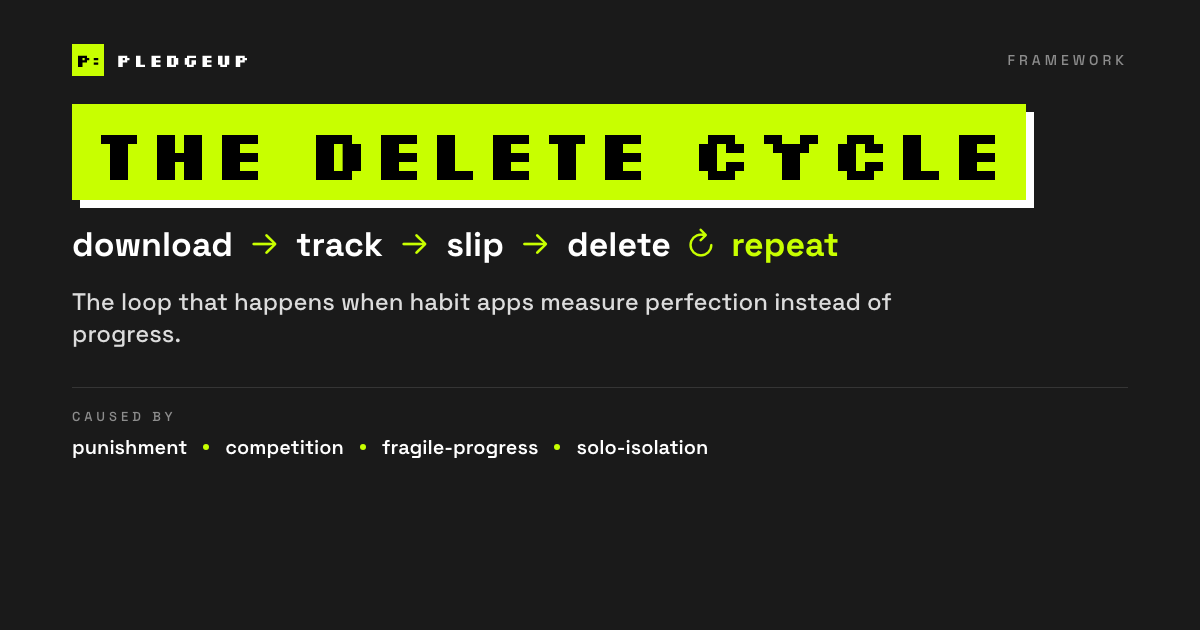
Most habit apps can't offer this. Building real social accountability that isn't competitive is hard, and most product teams default to simpler mechanics. So the loop stays solo, and the delete cycle keeps turning.
what pledgeup does instead
That's what PledgeUP is built around.
We started with an observation: the habits that stick usually have a person attached to them. Not an app. Not a notification. A friend who asks "how'd it go?" and waits for the answer.
So we built around that. You create a challenge with friends. You check in when you show up — with a photo, a GPS ping, a timer, or just your word. Your friends see it. Your friends notice. That's the mechanism.
Nothing resets to zero. We track consistency — how often you show up relative to how often you said you would. Miss a day? The rate drops slightly. Show up tomorrow and it climbs. The incentive stays pointed in the right direction: keep going matters more than never missing.
And if you want your stakes to mean something beyond yourself, you can pledge to a charity through our verified giving partners. Purpose alongside progress. That part's optional — the friend part isn't.
We're running in beta. Around a hundred early testers have been trying it out over the past few months, sending through what works and what doesn't. Their feedback is shaping every design call we make. We're not claiming we've solved habit formation. We're saying the existing approaches have well-documented design flaws, and there's a pattern worth building around that nobody else is.
The pattern is simple: real friends, not leaderboards. Check-ins, not counters. Consistency, not perfection. And no resets — not because we're going easy on you, but because the reset never matched how people actually build habits in the first place.
It starts with you, but it ends with others.